






James Gunn’s DC Universe began its theatrical run a year ago, with Superman‘s premiere last July. The next entry in the DCU fleshes out the Super family with Supergirl. Within seconds of her appearance in Superman’s conclusion, it was obvious this version of the character would be much different from previous on-screen iterations.
The film is an adaptation of the graphic novel Woman of Tomorrow by writer Tom King and artist Bilquis Evely. Supergirl, directed by Craig Gillespie, stars Milly Alcock as the titular character and is now in theaters everywhere.
Milly Alcock Delivers a Super Performance

Firstly, Alcock is incredible as the Girl of Steel. Kara has had a life completely different from her superhero cousin. Unlike Clark, she grew up speaking Kryptonian and had to adapt to life on Earth after a tremendous loss. Kara knew her parents; she grew up in a Kryptonian city and is the one person who remembers what it was like.
The film grapples with what such loss does to someone, what kind of person do you become when you’ve witnessed the death of your planet? As seen in Superman, Kara turns to partying on planets with red suns, since those are the only planets where she can feel the effects of alcohol. She’s not afraid to pick a fight, and there’s no shortage of action. This is how we’re introduced to Ruthye, played by Eve Ridley.
Ruthye is a teenage girl who has also experienced loss and seeks revenge against Krem the Brigand (Matthias Schoenaerts) for the murder of her family. Kara sees a bit of herself in Ruthye, and both are shaped by grief in different ways, allowing them to help each other process their loss.
Red, Blue, and Too Much Grey in ‘Supergirl’
Like last year’s Superman, Supergirl is a film about finding yourself. However, where Superman is a tale of exploration when your worldview is shaken, Supergirl is a film journey about recovering after unfathomable loss. Kara doesn’t have a homestead to fall back to or her parents to give her a motivational speech. She hasn’t let anyone in, and so Kara’s journey is hers alone. But once Kara Zor-El finds herself, it’s a beautiful sight. Claudia Sarne’s score in the scene where this happens, in particular, is so moving. However, the film’s visuals are not always up to par.
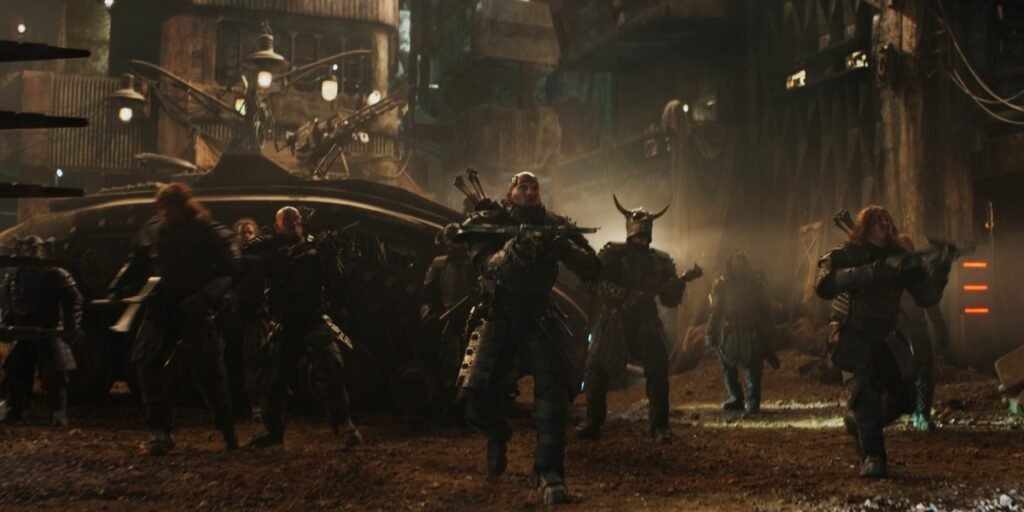
Supergirl has a distinct look at times as the interstellar journey takes us to many different planets. There are yellow suns and red suns, a beautifully blue planet with rings, but the film also has a lot of gray. There are many parts of the film that are on the darker side. At times, it was hard to see all of the details, which is unfortunate given how colorful the comic the film is based on is.
One can argue that this relates to the film’s darker tone, as later in the third act it becomes noticeably brighter, especially once Kara has found her emotional footing. However, the film doesn’t take advantage of a darker color palette and looks average at times. The fight scenes stand out, often feeling like comic book pages brought to life, and typically are where the film’s visuals are at their best.
‘Supergirl’ Contains Changes From Tom King’s Iconic ‘Woman of Tomorrow’ Comic

One of the major plot points is Ruthye’s yearning for revenge, and Kara’s protests against it. However, the film never explains why Kara feels so strongly against Ruthye’s quest for vengeance. Whether this is a plot point left unresolved due to production reasons, or if that’s a story for another day, remains to be seen, but it leaves a question mark on the narrative of this film in particular.
While the story is a fairly faithful adaptation, there are still plenty of changes from the Woman of Tomorrow comic. Some of the changes, like Kara’s age, are crucial components of Kara’s character and alter the severity of the grief and loss her comic counterpart has experienced. This does not change her journey in the film to a massive degree, but it is an interesting choice that is sure to spark discussion.
Kara Has to Earn Her Stripes in ‘Supergirl’

A common complaint in comic book movies is that a character has to build their suit or level up to earn their costume. In Supergirl’s case, Kara has to get to a place emotionally where she can wear her iconic costume. She has a conversation at the beginning of the third act that hints at her apathy toward the suit, but to see her explicitly reject wearing the iconic costume, or be uncomfortable in it as part of her hero’s journey, would have been an interesting way to mirror her emotional arc while in costume. These are some examples of how the script has some really interesting ideas that aren’t fully realized.
Supergirl is a character study that ties Kara’s bond with her dog, Krypto, to the world of loss she’s already experienced. The film also continues to expand the DCU with new worlds and characters, such as the enigmatic and hilarious Lobo (Jason Momoa). While certain choices change the source material without elevating Kara’s characterization, the film remains a fun DCU entry with strong highs, though uneven in execution.
For more coverage of Supergirl, subscribe to the Agents of Fandom YouTube channel! Make sure to follow the Agents of Fandom socials for the latest entertainment news and reviews.
'Supergirl' Review
'Supergirl' ReviewThe Good
- Milly Alcock shines as Supergirl, solidifying herself in the role for years to come.
- The action sequences provide exciting visuals.
- Jason Momoa is hilarious as Lobo.
The Bad
- Many settings are far too grey, as the film fails to be as colorful as the comic.
- Certain themes in the script are interesting when presented, but never get resolved.
- The iconic comic villain Krem fails to live up to his written counterpart.